My Odyssey - Motivation app with crowdfunding system, AI and Real Stakes

Live Link: https://myodyssey.me/
Repo: https://github.com/Greyewi/myOdysseyMetis
Whitepaper: https://myodyssey.me/uploads/whitepaper.pdf
My vision: https://myodyssey.me/uploads/vision_future_direction.pdf

My Odyssey – Goal Setting with Real Stakes
Problem Statement

Millions of people struggle to achieve personal goals due to a lack of structure, accountability, and long-term motivation. Traditional to-do lists and habit trackers often fail because they lack real consequences for failure or incentives for follow-through.

Solution Overview

My Odyssey is a goal-setting app powered by AI. Users define a goal, stake crypto funds as a personal commitment, and gain support from backers. If the goal is completed on time, the funds are returned (plus potential rewards). If the user fails, the funds are redistributed. AI assists with verifying the realism of the goal and generating actionable subgoals. All interactions are transparent and on-chain, ensuring accountability and trust

Project Description

My Odyssey empowers users to transform their ambitions into accountable on-chain journeys. The process begins by setting a goal, choosing a deadline, and locking a crypto stake. Users can optionally receive support from friends or public donors. The funds act as both commitment and potential reward

AI models verify the realism of the proposed goal based on timeframe, complexity, and user context (skills, past completions, etc.). Upon approval, AI then generates a set of subgoals to guide the user. Users update their progress through the app or via proof-based uploads (e.g., image/video/text proof). At the deadline, the goal is marked as complete or failed.

The platform combines:
– Based on (EVM / Metis) for fund logic (potentially smart contracts)
– AI agent for goal validation and planning
– Gamified UX to keep users engaged
– Transparent progress history on-chain

What excites us is creating a digital space where self-discipline is rewarded with both credibility and real assets - and where failure contributes to a collective funding pool for others to try again

Community Engagement Features

My Odyssey empowers users to promote their own goals - and the platform — by sharing their journey publicly on social media

What Users Can Do:
– Create a goal: Each goal has a unique public page with a shareable link
– Share their goal on social media (Instagram, Telegram, X, etc)
– Post regular updates about their progress, challenges, and milestones
– Celebrate completion by sharing their success story
– Tag My Odyssey or use a hashtag to amplify their reach and help others discover the platform

Why This Matters:
– Every shared goal promotes both the user’s journey and My Odyssey
– Public accountability strengthens motivation and follow-through
– The platform becomes a place for real stories — inspiring others to take action
– This approach leverages users’ own networks to grow the community naturally, turning every goal into a story worth spreading

Getting Involved

My Odyssey is a solo project - I’m handling everything from concept to code myself. That said, I truly need community feedback to make this platform meaningful and useful

I’d be incredibly grateful if you could:
– Share your honest thoughts or suggestions in the forum thread
– Tell me what’s unclear or could be improved
– Offer feedback on the flow, UI, or concept once the prototype is up

Your input can help shape this into something real - I can’t do it in a vacuum

https://myodyssey.me/uploads/vision_future_direction.pdf

https://github.com/Greyewi/myOdysseyMetis

32 Likes

Thanks for sharing your project! Quick question:

How do you plan to handle disputes or disagreements about whether a goal was truly completed, especially when proof might be subjective?

6 Likes

That’s a great and complex question.

My current approach prioritizes self-assessment and personal integrity. The core idea of the app is to help users achieve meaningful goals through commitment, not punishment. If someone chooses to lie or fake their success, it mostly undermines their own progress — the real loss is theirs.
In the future, I plan to explore optional external verification (e.g., curators, social proof, or lightweight AI checks), but the MVP is built around trust and personal responsibility.

4 Likes

Thanks for the clear explanation! Trust and personal responsibility are great foundations for the app.

Quick question: How do you plan to encourage users to stay honest and engaged without strong external enforcement?

4 Likes

I believe external enforcement isn’t always necessary when social dynamics are in place. One of the core features of the app is crowdfunding — users can receive donations for their goals, but people won’t donate unless they see genuine effort and commitment.
To support this, I’m building an AI-powered task system that helps users break down goals into clear, actionable steps. This not only builds transparency but also keeps users accountable in a natural, community-driven way.

However, I’m also exploring new ways to encourage users. In cases where goals can be clearly defined and objectively evaluated, it may be possible to introduce verification mechanisms to provide proof of completion. But I think it too much for MVP.

4 Likes

Thank you for sharing these insights! It sounds like a thoughtful balance between community trust and practical verification. Looking forward to seeing how it develops!

4 Likes

This is a really interesting concept ! Here are some questions that could help you refine your project.

  1. Could you elaborate on the “redistribution” of funds if a user fails? Where do these funds go (e.g., to their backers, a general community pool for new users, burned, platform treasury)? What’s the philosophy behind this choice?
  2. What are the “potential rewards” for completing a goal, beyond getting the initial stake back? Do these come from backers, interest generated on the staked crypto, or a platform incentive pool?
  3. What kind of data will the AI use to “verify the realism of the proposed goal based on timeframe, complexity, and user context”? How will user privacy be handled concerning this contextual data?
  4. Many personal goals can be subjective (e.g., “be happier,” “learn to be more patient”). How will the AI approach validation and subgoal generation for such qualitative goals compared to more quantifiable ones (e.g., “run a marathon,” “finish a coding course”)?
  5. What happens if a user disagrees with the AI’s assessment of their goal’s realism or the actionability of the generated subgoals? Is there an override or appeal mechanism?
  6. For “proof-based uploads (e.g., image/video/text proof),” who or what verifies the authenticity and relevance of this proof? Is it the AI, backers (if any), or a community consensus mechanism?

Thank you

8 Likes

Hello @Greyewi

  1. What do you think about using AI to verify goals and generate subgoals?
  2. Would seeing on-chain history of past goals from other users increase your trust or interest?
  3. What kind of rewards or achievements would keep you engaged throughout your goal?
7 Likes

Thank you very much for your thoughtful questions — I truly appreciate the interest in my project.

Could you elaborate on the “redistribution” of funds if a user fails? Where do these funds go (e.g., to their backers, a general community pool for new users, burned, platform treasury)?

The user can choose where the funds will go if they fail the goal. Available options include:

  • Donation to charity
  • Contribution to the platform development fund
  • Sending to a custom wallet address (e.g., a friend, as part of a bet)

I’m also considering allowing redistribution back to the donors, but I’m cautious about potential abuse or speculation, so this feature is still under review.

What’s the philosophy behind this choice?

I don’t treat failed-goal funds as revenue for the platform. Ideally, users will choose to send their failed funds to charity — this increases the psychological cost of failure and encourages commitment. I’m also exploring an optional mechanism where users can send a portion of funds to charity even upon success, as a form of “giving back.”

What are the “potential rewards” for completing a goal, beyond getting the initial stake back?

If the user completes the goal, they receive back their own stake — plus any donations from supporters. That’s the core incentive.

Do these come from backers, interest generated on the staked crypto, or a platform incentive pool?

All additional rewards come purely from donations. The system avoids generating rewards via platform funds or mechanisms that could enable speculation.

What kind of data will the AI use to “verify the realism of the proposed goal based on timeframe, complexity, and user context”?

I’ve conducted initial research and defined a simple template for MVP:

  • Goal description
  • Deadline
  • Weekly time commitment
  • Current experience level
  • Available resources
  • Initial actions taken

These inputs are collected through the goal creation form and help the AI assess feasibility.

How is user privacy handled with this contextual data?

The user will have a public goal card where they can choose which data to display. The internal feasibility analysis will only publish a final score or summary — not the raw personal inputs — unless the user opts to share them.

Many personal goals can be subjective (e.g., “be happier,” “learn to be more patient”). How will the AI approach validation and subgoal generation for such qualitative goals compared to more quantifiable ones (e.g., “run a marathon,” “finish a coding course”)?

The AI isn’t limited to objective goals. It can also generate subgoals for qualitative objectives — for example, “practice gratitude journaling” or “meditate daily.”

Since donations are made by real people, I believe some supporters may even prefer meaningful, personal goals. My goal is to test this hypothesis and adjust if abuse is reported.

What happens if a user disagrees with the AI’s assessment of their goal’s realism or the actionability of the generated subgoals? Is there an override or appeal mechanism?

No problem — the AI is a recommendation engine. It highlights weak points in the plan and suggests edits. All subgoals are editable, so the user has full control.

Is there an override or appeal mechanism?

In the MVP, a goal can be canceled only if there are no donations. In the future, I’ll introduce a system to refund donations back to users in a secure and transparent way.

For “proof-based uploads (e.g., image/video/text proof),” who or what verifies the authenticity and relevance of this proof? Is it the AI, backers (if any), or a community consensus mechanism?

In the MVP, proof is self-submitted by the user. Optionally, they can assign a curator (like in Stickk) to verify success. Later, I may integrate third-party verification protocols or lightweight AI models to help assess uploaded evidence.

4 Likes

You’re building something that blends behavioral psychology, crypto-native design, and community storytelling — and that’s rare. The solo-founder angle makes this even more impressive. If you can nail the verification UX and find an early group of users to test and iterate with, this could be a truly sticky product.

4 Likes

Hello there! @priyankg3

What do you think about using AI to verify goals and generate subgoals?

I already have this idea. The AI helps evaluate the realism of a goal based on user context and can generate editable subgoals to break down the journey.

Would seeing on-chain history of past goals from other users increase your trust or interest?

Definitely — on-chain goal histories would improve transparency and build trust. It could also serve as inspiration and motivation for new users.

What kind of rewards or achievements would keep you engaged throughout your goal?

The main incentive is financial — reaching the goal unlocks the staked funds and donations. However, I’m also exploring additional rewards like NFT badges, reputation scores, or even airdrops tied to consistent progress or successful completions.

4 Likes

Thank you! I’ve been thinking about this idea for several years and have gone through many iterations. I truly believe in its potential, and I’m hopeful that this version will be the one that finally sticks. I’m excited to keep refining it — especially with real users — and make something meaningful.

5 Likes

This is a truly inspiring concept thank you for sharing it so openly. One question I have:

How does My Odyssey ensure fair and accurate verification of goal completion, especially for subjective or creative goals?

Looking forward to seeing how this evolves. Best of luck, and thanks again for inviting the community to be part of the journey!

3 Likes

Thank you so much — I really appreciate your kind words and thoughtful question!

My Odyssey is built on the idea that self-improvement is personal, and that trust, context, and intention matter deeply — especially when goals are creative or subjective.

For now, goal verification is flexible:

  • Some users may simply self-confirm their progress — the goal is growth, not policing.
  • Others may invite a curator (like in Stickk) — a friend, mentor, or community member who can confirm the result.
  • In the future, for more objective goals, we plan to explore lightweight AI verification, or even on-chain proof-of-progress.

But most importantly: if a goal is subjective (e.g. “become more confident”, “write poems weekly”), we don’t want to over-engineer it. My Odyssey supports reflection, journaling, and sharing — so users can build a narrative and earn support not just by outcomes, but by showing up.

This is still evolving — and feedback like yours helps shape it. Thanks for being part of the journey :raising_hands:

3 Likes

Thank you so much for the thoughtful and heartfelt response it really shows how much care and intentionality you’re putting into My Odyssey. I love the balance between accountability and personal growth, especially the idea of embracing subjectivity and narrative over rigid metrics. It’s refreshing to see a platform that values “showing up” as much as outcomes. I’m genuinely excited to see how this evolves and honored to be part of the conversation. Keep building! :raising_hands:

3 Likes

wow ! thanks a lot for detailed answers. Looking forward for the project. All the best :slight_smile:

5 Likes

:rocket: Hey friends!
Super excited to give you a peek behind the scenes of My Odyssey — the app that helps you stay accountable, dream big, and actually get things done! :flexed_biceps::sparkles:

Here’s a quick look at our current architecture powering the journey:

:brain: AI Agent – Powered by LazAI, this is the brain behind goal evaluation and smart subtask generation.
:gear: Backend API – Built with Express.js, it’s the core engine that keeps everything running smoothly.
:repeat_button: Job Workers – Background magic happens here with a PostgreSQL pool managing async tasks and updates.
:file_cabinet: Database – A solid foundation on PostgreSQL to securely store goals, progress, and more.
:globe_with_meridians: Showcase – Our public-facing Next.js site that explains the vision and invites others to join.
:compass: Cabinet – The personal dashboard built with React, where users track their goals and progress day by day.

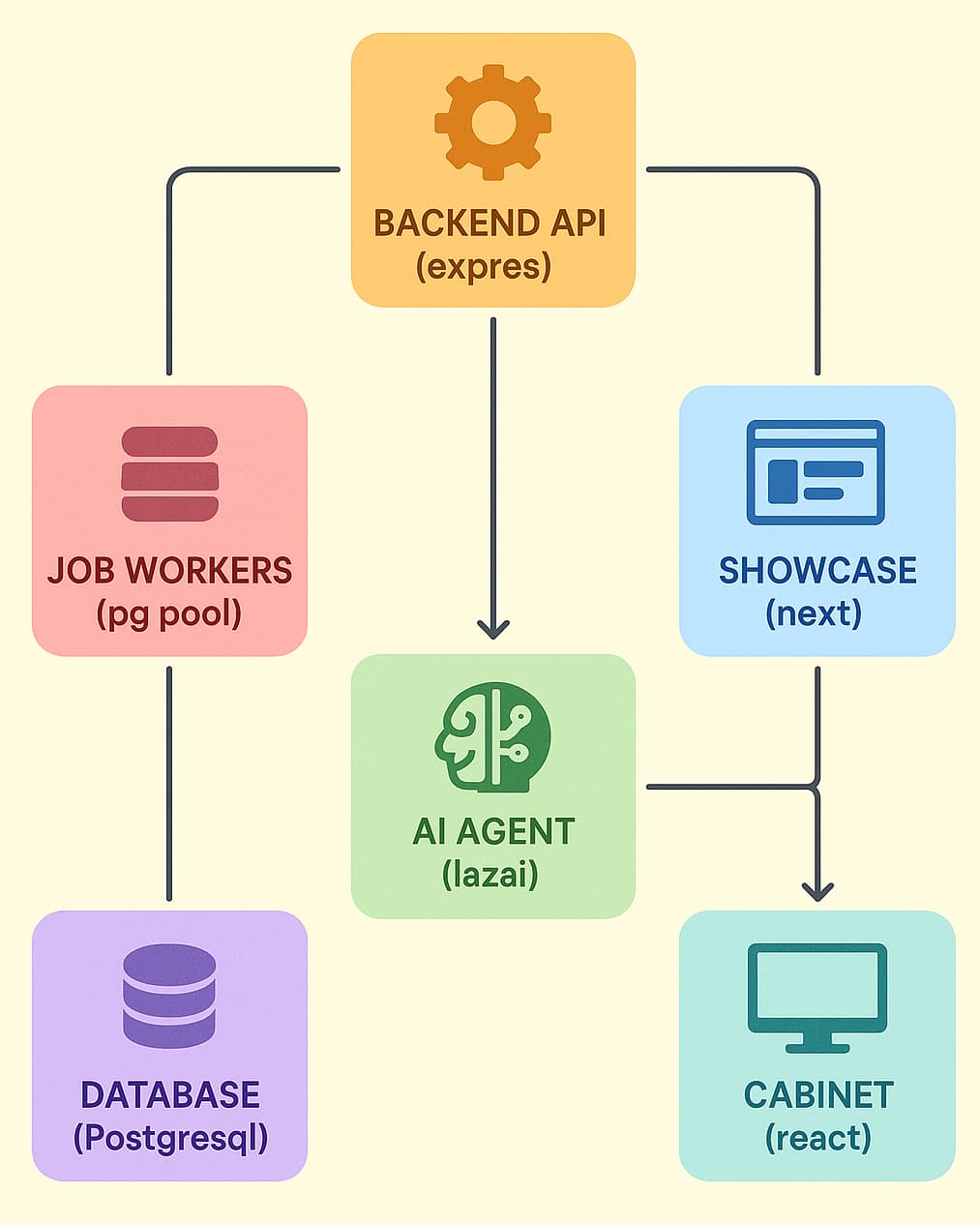
We’re combining tech with purpose, and this is just the beginning. Stay tuned for more updates as we bring My Odyssey to life! :seedling::globe_showing_europe_africa:

I’m happy to share that the MVP is almost ready, but it takes some transformation. Now it transforms from a social motivation app to an interactive motivational assistant. It still has the social approach, but I wonder how convenient to reach goals with this assistant. I am just tried this app in myself and it was cool.
And I’m a bit afraid to show it because it still has several issues with UX. I hope that I will fix them in 2 weeks.

4 Likes

:folded_hands: I’d really appreciate it if you could take a moment to fill out this short survey about the motivational app I’m building.

I’m currently working solo and feeling a bit uncertain about the best direction to take. Your feedback would really help me focus my energy where it matters most.

Thank you so much for your time and support! :light_bulb::sparkles:

3 Likes

I love this idea of using AI to solve real-life issues. Consider clarifying exactly how AI validates goal realism, redistributes funds upon failure, and manages user privacy.

4 Likes

Thank you very much for your thoughtful questions — I truly appreciate your interest in my project. I’m happy to share more details below.

— How AI validates goal realism:
The user fills out a form with four fields: hours per week, current experience level, available resources, and current progress. If any critical information is missing, the AI assumes it’s lacking, lowers the success probability, and adds relevant tasks to address the gap. The AI also analyzes the user’s goal history to evaluate how similar goals were previously completed.

— Redistributes funds upon failure:
This feature is still being tested. Many users prefer not to lose their funds, so I’ve added an option to refund the money if the goal isn’t achieved. However, users can also choose alternative outcomes—such as donating the funds to charity or keeping them within the platform. I’m also exploring a model where the funds are redistributed to the donors.

— Manages user privacy:
KYC is not required. Users can authenticate using a wallet only.

3 Likes