TL;DR
Three connected proposals in one: a clear standard for when the community votes are required, a structured public record for decisions that do not meet that standard, and a declared intent to build our governance on our own blockchain. No invented numbers. No fake finish lines. This is what honest governance looks like at this stage.
Context
The governance framework we approved in February 2024 was built for a different phase - one with active participation and a steady flow of contested decisions. Neither is true today. We are in a path-finding mode, and we are not pretending otherwise.
This proposal does not abandon governance. It adapts it. There is a difference between suspending accountability and being honest about what meaningful accountability looks like right now.
In October 2025, Elena stated publicly in response to the community questions about centralization:
“Over time, as the ecosystem matures, this shared responsibility will gradually evolve toward greater participatory governance and on-chain decision-making.”
This proposal is the mechanism that delivers on that commitment.
Alternative considered: Maintain the existing framework - use Snapshot when a vote is required, no structural changes.
Rejected because current participation levels make scheduled community votes a formality rather than a genuine input mechanism, and the existing framework creates no structured record of leadership decisions between votes. The status quo provides neither meaningful community participation nor transparent accountability.
Part 1: The Meaningful Vote Standard
Context: The existing framework treats all decisions as equally requiring community votes. With near-zero participation, this produces governance theatre - votes that look like community input but are not. A clear principle is needed to distinguish decisions in which community input genuinely matters from those in which it does not.
Impact: Community votes become rarer but more meaningful. Token holders who participate know their vote counts because the decision is genuinely open. Decisions below the standard are handled transparently through the Leadership Decision Registry (Part 2). Trade-off: leadership has more unilateral authority in the short term, offset by the mandatory public accountability structure in Part 2.
Alternative considered: Continue requiring that all decisions go to Snapshot, regardless of participation. Rejected because running votes with negligible participation does not produce legitimate governance outcomes - it produces the appearance of legitimacy, which is worse
than acknowledged structure.
Community votes are reserved for decisions that meet all three criteria:
- The outcome is genuinely uncertain — community input could change the result
- Real trade-offs exist between alternative paths
- The decision has a material impact on token holders or the broader ecosystem
Part 2: Leadership Decision Registry
Context: Without a structured record, decisions made between Snapshot votes are invisible to the community. The LDR creates the accountability layer that legitimizes reduced voting frequency. Reducing voting without a record is centralization. Reduced voting with a mandatory public record is an adaptation.
Impact: Every operational decision is publicly documented with mandatory reasoning on the governance forum. The community gains a formal challenge mechanism with an enforced response deadline. Leadership accepts the obligation to justify decisions publicly on a fixed timeline. Trade-off: more process discipline required from leadership; more transparency and structured recourse for the community.
Alternative considered: Publish decisions informally - announcements, blog posts, ad-hoc forum updates. Rejected because informal publication carries no standard format, no mandatory
reasoning, no challenge mechanism, and no permanent governance record. It is accountability in appearance only.
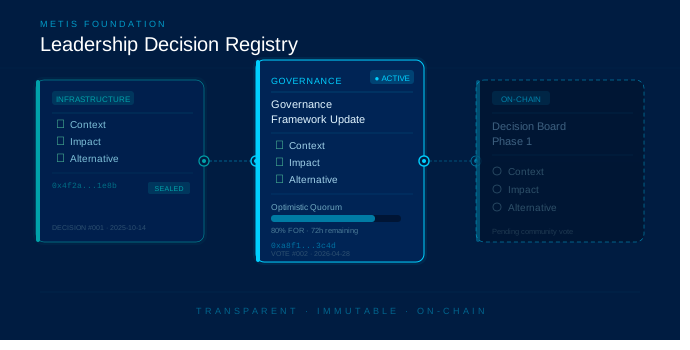
The Leadership Decision Registry category is already live on the forum:
 Leadership Decision Registry
Mandatory entry format
Every LDR entry must answer three questions - no exceptions:
- Context: Why is this decision being made now?
- Impact: What is the specific trade-off or consequence?
- Alternative considered: What was the other option, and why was it not taken?
Decision categories covered by LDR authority
| Category | Examples |
|---|---|
| Infrastructure | Sequencer operator onboarding, technical parameter changes, network configuration |
| Partnerships | Ecosystem integrations, analytics, tooling |
| Operational | Allocations within approved reserves, process adjustments |
| Administrative | Forum structure, templates, process updates that do not affect voting frameworks |
No financial thresholds are defined at this stage. We will not invent numbers to fill a governance checkbox. If a decision feels outside the scope of leadership authority, it goes to a community vote regardless of category.
Community challenge process
Any community member may formally challenge an LDR decision within 7 days of publication by posting a challenge reply on the forum. The governance team must respond within 7 days by either:
- Initiating a Snapshot vote under the Meaningful Vote Standard, or
- Publishing explicit reasoning for why the decision does not qualify for escalation
If no response is published within 7 days, the decision is automatically escalated to a community vote. The deadline has teeth.
Conflict of interest disclosure
Any decision in which a leadership member has a direct personal financial interest- such as counterparty involvement, an equity stake, or prior employment within 24 months must be disclosed in the LDR entry and is automatically subject to the community challenge process, regardless of the decision category.
Part 3: Path to Native On-Chain Governance
Context: Metis governance currently depends on Snapshot.org, a proprietary third-party platform. This creates a structural dependency that contradicts Metis’s foundational position: that blockchain infrastructure provides trust, transparency, and immutability natively. A project that builds this infrastructure for others should use it for itself.
Impact: Governance records move to Metis L2, where they are permanently immutable and publicly queryable without relying on any external service. In a later phase, community voting moves on-chain as well, making Metis governance fully self-sovereign. Trade-off: requires development capacity at a time when the team is focused on product. No deployment date is committed - this is a declared direction, not a scheduled delivery.
Alternative considered: Continue using Snapshot indefinitely. Rejected on both ideological and structural grounds.
Ideologically: a blockchain project routing its own governance through someone else’s proprietary platform contradicts its core position.
Structurally: Snapshot represents an ongoing external dependency whose terms, pricing, or availability could change.
Ideological position: We should govern ourselves using the tools we build for others. This is not a slogan - it is an architectural commitment.
We are announcing our intent to build native governance infrastructure on Metis L2 - a smart contract that records every LDR decision permanently on-chain, with immutability guaranteed by the blockchain itself. When capacity allows, the community will be notified on this forum before deployment. This proposal asks for endorsement of the direction, not authorization of a specific contract on a specific date.
How the Framework Evolves
We will not define a metric-based trigger for reactivating broader community voting. Nobody knows what the right numbers are today, and pretending otherwise is governance theatre.
What we commit to instead: a quarterly public review - July 2026, October 2026, January 2027 - published on this forum, naming specific observations and producing one of three explicit outcomes:
- Expand: Community voting scope is broadened, with specific decisions moved from LDR to Meaningful Vote Standard
- Maintain: Current framework continues - with explicit reasoning published. Doing nothing requires the same public accountability as changing something
- Restructure: A new governance framework proposal is submitted to the community
We also acknowledge openly that the structure of the Metis Foundation itself may evolve. Whether it transitions to another form, or develops a hybrid model is an open question. This framework is designed to function under that uncertainty - adapting to conditions rather than enforcing a timetable.
Voting Details
| Platform | Snapshot |
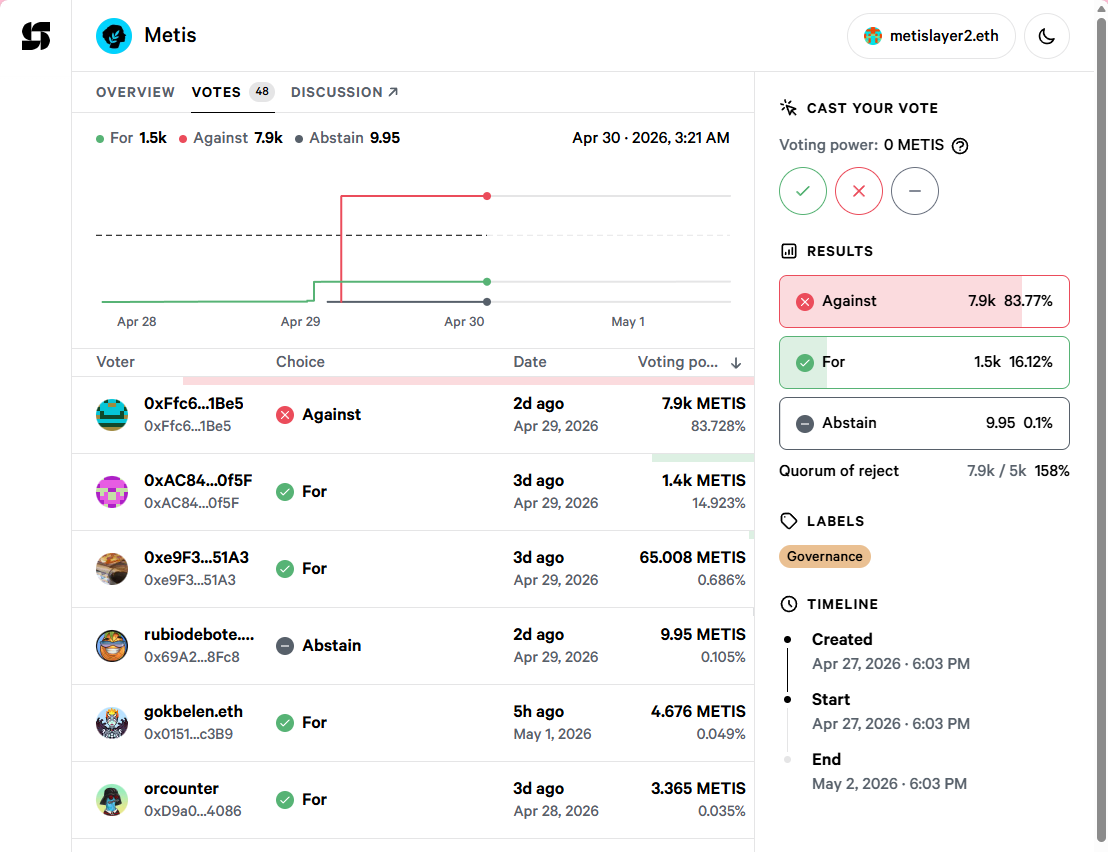
| Mechanism | Optimistic Quorum - rejected only if AGAINST votes exceed 5,000 METIS |
| Duration | 72 hours |
Submitted by
Kevin Liu, Founder, Metis Foundation
Andrei Sinelnikov, Governance & Process Lead, Metis Foundation