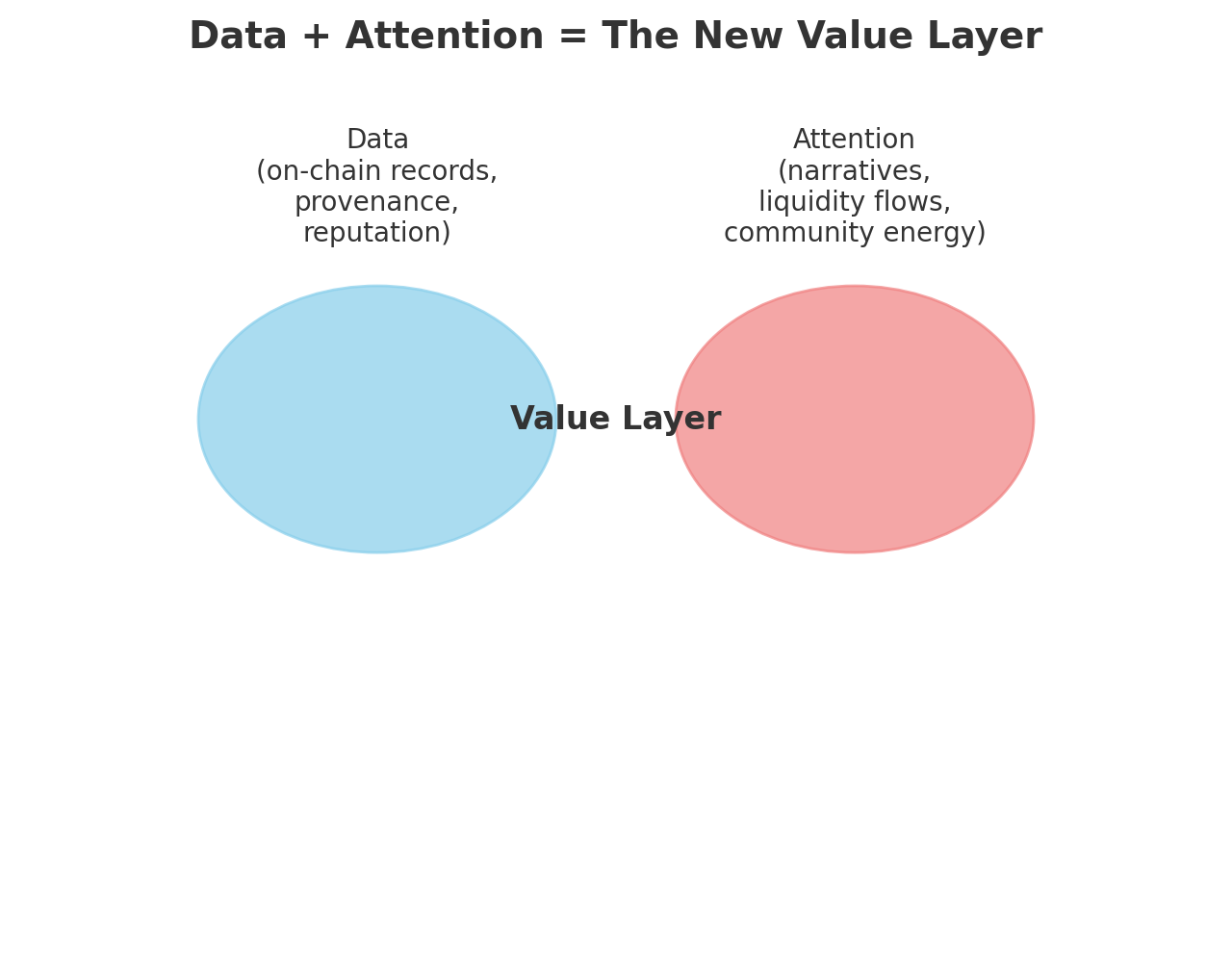
For years, tokens have been seen as the foundation of Web3. They move markets, drive speculation, and anchor governance. But if we zoom out, it becomes clear: tokens are not the true primitives of this space. They are wrappers. The real value layer is built on data and attention.
Data as the Invisible Collateral
Every action on-chain leaves behind a trail—transactions, signatures, provenance, metadata. This data isn’t just exhaust; it is the invisible collateral that powers reputation, lending, and liquidity.
-
A wallet’s trade history becomes a credit profile.
-
A project’s transaction flow becomes proof of traction.
-
A dataset of user behaviour becomes an input for AI-driven predictions.
Tokens may represent value, but it is data that determines whether that value is credible, sustainable, and worth trusting.
Attention as the Fuel of Liquidity
Markets don’t simply follow fundamentals. They follow attention. Communities don’t migrate to ecosystems because gas is slightly cheaper. They move because the conversation, builders, and narrative energy live there.
-
Attention directs liquidity more effectively than incentives.
-
Narratives shape network effects faster than token emissions.
-
The projects that dominate headlines often dominate TVL soon after.
In this sense, attention is programmable capital—it can be directed, amplified, and monetized, just like liquidity pools.
Programmable Attention in Web3
The difference with Web3 is that attention is no longer abstract. It can be measured, tokenized, and redistributed. Incentives can be tied directly to verifiable actions—staking, voting, testing, content creation. AI agents and filtering systems are already emerging to channel attention efficiently:
-
Curators that rank signals over noise.
-
On-chain identities that validate contributions.
-
Reward systems that pay out for verified engagement.
We are entering an era where ecosystems will compete not only for liquidity, but for programmable attention flows.
The Future Stack: Data + Attention as Assets
The winning networks of the next decade will not be the ones with the most tokens in circulation. They will be the ones that can capture, structure, and reward data and attention as native assets. Tokens will remain important, but they will be shells—the pearls inside are the information and energy they carry.
If data and attention are the new primitives, the real question is this:
Who is building the infrastructure to capture them, structure them, and make them verifiable, composable, and monetizable across ecosystems?
That, more than tokenomics alone, will decide which networks define the future.
 . I agree that data and attention are becoming the true assets of the future. In your view, how can the Metis ecosystem play a unique role in this vision of “programmable attention” and “data as invisible collateral”? What distinctive advantages could set Metis apart?