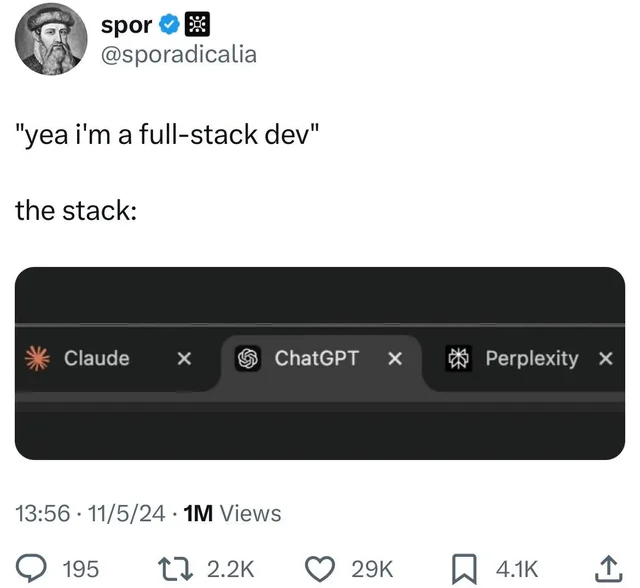
There was a time when being full-stack meant you could handle everything from database to frontend and still have the energy to debug at 2 AM. You were the person who could build an idea from scratch, one commit at a time. That used to be the badge of versatility.
But now, things are different. AI has changed the rhythm of how we build. Code assistants, design generators, and deployment bots have blurred the old lines. Suddenly, being “full-stack” isn’t just about touching every part of the codebase. It’s about understanding how to connect the right pieces together.
You don’t need to write every line anymore. You need to understand how the system works as a whole. You might not be the database expert or the CSS magician, but you know how to bring it all into one flow, using AI where it makes sense and humans where it matters.
The best developers now are less about doing it all themselves and more about thinking across layers. They can talk to AI tools like collaborators, not crutches. They can translate ideas into systems quickly, not because they type fast, but because they think in structures.
Being full-stack in 2025 isn’t about mastering every framework. It’s about mastering adaptability. It’s about curiosity, clarity, and the confidence to let AI handle the heavy lifting while you stay focused on the bigger picture.
In this new world, the real “stack” is human creativity, collaboration, and smart automation.
If you can work across those layers, you’re as full-stack as it gets.
