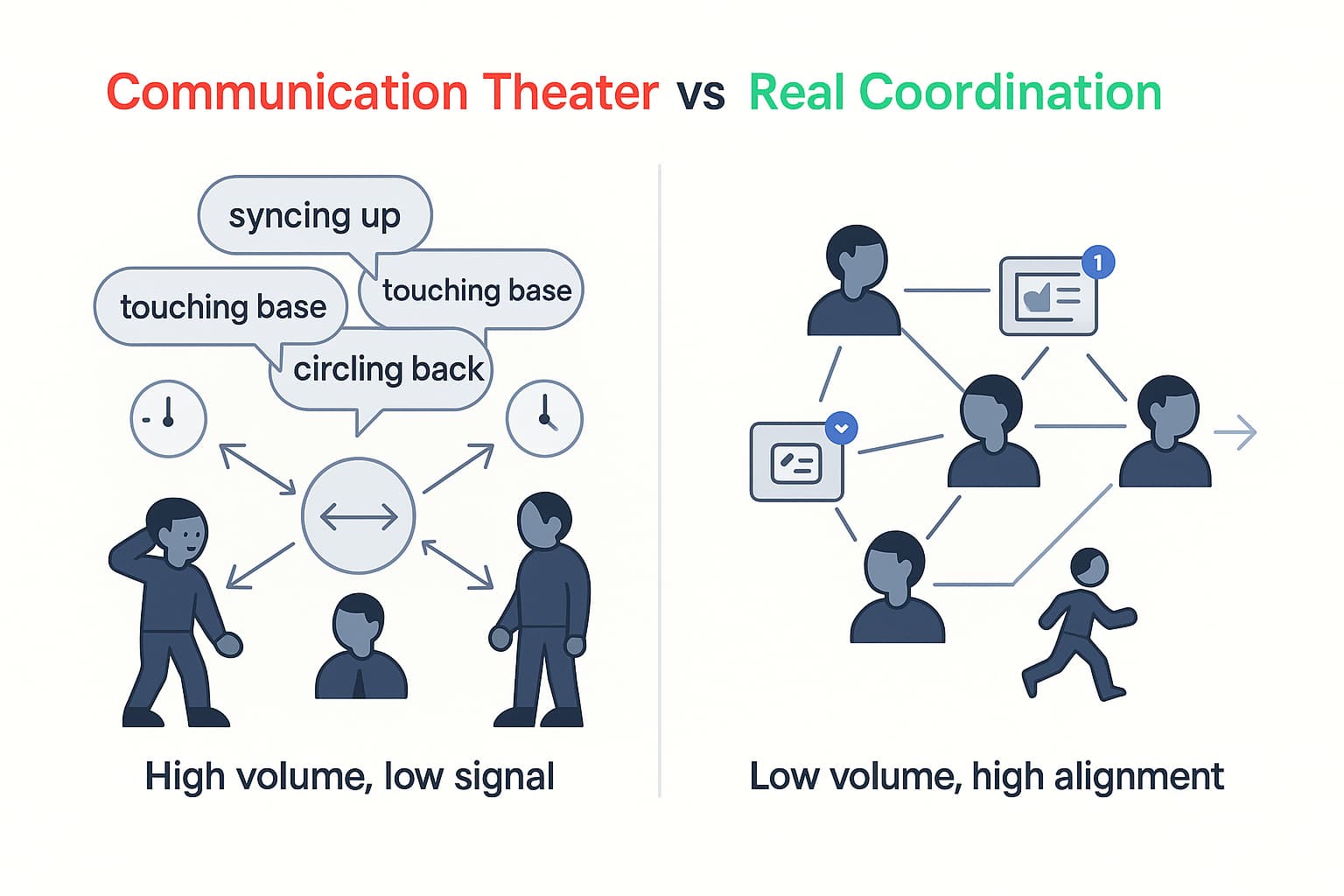
Your team added three more check-in meetings this month. Alignment got worse, not better. Here’s why coordination theater is killing your operational effectiveness.
I’ve watched this pattern destroy more crypto teams than market crashes or technical failures combined. A project starts with five people who can read each other’s minds, ship features in days, and pivot on a Discord message. Six months later, they have daily standups, weekly planning sessions, monthly retrospectives, and quarterly all-hands meetings. Everyone’s talking constantly, but nobody knows what anyone else is actually building.
Sound familiar? You’re caught in the coordination trap, and more communication isn’t the cure, it’s the poison.
The Communication Fallacy That’s Killing Crypto Teams
Most operators treat communication and coordination like they’re the same thing. They’re not. Communication is information transfer. Coordination is synchronized action toward shared outcomes. The relationship between them isn’t linear, it’s inversely correlated past a certain point.
Think about your most successful shipping period. Was it characterized by endless meetings discussing what to build, or by everyone intuitively understanding the direction and executing in parallel? The answer reveals why our industry’s obsession with “improving communication” often makes teams slower, not faster.
In crypto, where market windows are measured in weeks and technical advantages evaporate overnight, coordination delays are existential threats. While your team is perfecting their communication rituals, competitors are shipping.
Here’s what most operators miss: human attention and decision-making capacity are finite resources that communication consumes rather than generates. Every message, meeting, and update request depletes the cognitive budget available for actual work. When everyone needs to know everything, nobody knows anything important.
The ALIGN Method: Building Real Coordination
After watching dozens of teams struggle with this challenge, I’ve identified five principles that separate genuine coordination from communication theater:
Asynchronous by default: Real coordination happens in people’s heads and in the work itself, not in conference rooms. Synchronous communication should be reserved for true collaboration—creative work, conflict resolution, and strategic pivots. Everything else should flow through systems that let people engage when they have capacity and context.
Lightweight information architecture: Instead of comprehensive updates that nobody reads, create lightweight signals that busy people can process instantly. Status should be visible in the work artifacts themselves (code commits, design files, dashboard metrics) not buried in meeting notes or Slack threads.
Intent-based decision rights: Rather than consensus-building on every choice, establish clear frameworks for who makes what decisions based on what criteria. When everyone knows who’s responsible for infrastructure decisions versus marketing messaging versus token economics, coordination becomes automatic.
Goal-oriented rather than task-oriented: Teams that coordinate around quarterly objectives spend less time discussing daily tactics. When everyone understands how their work connects to measurable outcomes, micro-management becomes unnecessary.
Networked rather than hub-and-spoke: Information should flow directly between people who need to coordinate, not through managers who become bottlenecks. Build systems where developers can communicate directly with community members, where marketing can access real-time product data, where operators can see user behavior patterns without scheduling meetings.
Case Study: How Uniswap Built a Billion-Dollar Protocol With Anti-Communication
Uniswap’s approach to coordination proves this framework works at scale. Despite managing the largest DEX in DeFi, their core team has remained intentionally small—under 30 people even as TVL exceeded $5 billion. They’ve explicitly rejected the “scale communication with headcount” approach that kills most startups.
Instead of daily standups and weekly planning meetings, Uniswap coordinates through code as documentation. Pull requests contain the context needed for decision-making. Their governance forum operates asynchronously, with proposals that include all necessary context rather than requiring live discussion to understand intent.
Most importantly, they’ve maintained clear decision rights. The core team handles protocol development, governance handles parameter changes, and community contributors focus on ecosystem growth. No consensus-building on routine decisions, no all-hands meetings to align on obvious priorities.
The result? They’ve shipped major features like v3’s concentrated liquidity, governance delegation, and cross-chain expansion without the coordination overhead that bogs down teams half their size. While competitors spent months in “alignment” meetings, Uniswab captured market share through execution speed.
This connects directly to challenges the Marketing Guild has discussed around campaign efficiency and the Builders Guild’s concerns about maintaining development velocity. Both are describing coordination problems disguised as communication challenges.
The Self-Assessment: Is Your Team Trapped?
Track how much time your highest-performers spend in meetings versus producing actual work. If your best operators, developers, or marketers are spending more than 20% of their time in “alignment” activities, you’ve prioritized process over performance.
Measure decision latency for non-critical choices. How long does it take to get approval for a $500 expense, a copy change, or a minor feature adjustment? If routine decisions require multiple touchpoints, your coordination systems are creating drag instead of lift.
Most telling: ask your team what they’d build if they had a week with no meetings and no requirements to update anyone on progress. If the answers excite you more than your current roadmap, coordination theater is constraining your potential.
Breaking Free: What Changes Tomorrow
The path out of the coordination trap isn’t about eliminating communication—it’s about making it intentional rather than habitual. Start by identifying which of your regular communication rituals actually produce coordinated action versus those that exist because “that’s how teams work.”
This is particularly crucial as crypto teams scale and competition intensifies. The organizations that figure out coordination without communication overhead will ship faster, iterate more effectively, and build stronger products.
For teams in the Hyperion ecosystem, this becomes even more critical as we approach mainnet. The velocity that made our testnet successful can’t survive traditional startup communication bloat.
What coordination rituals is your team performing that actually decrease alignment? More importantly, what would you build if your cognitive resources were freed from communication theater and redirected toward the work itself?
The market doesn’t care how well your team communicates. It cares what you deliver and how quickly you can adapt when you’re wrong. Choose coordination systems that serve that reality, not the other way around.