DAT Specification: Building the Foundation for Verifiable AI Ownership
In my previous article, I introduced the concept of the Data Anchoring Token (DAT) — LazAI’s token standard that anchors AI assets like datasets, models, and inferences on-chain.
Now, let’s go a level deeper — into how the DAT specification actually works, and why it’s a crucial building block for decentralized AI infrastructure.
 Understanding the DAT Specification
At its core, the DAT standard defines how an AI asset is represented, verified, and transacted in a Web3 environment.
It’s a semi-fungible token (SFT) — combining the uniqueness of NFTs with the divisibility and transferability of fungible tokens.
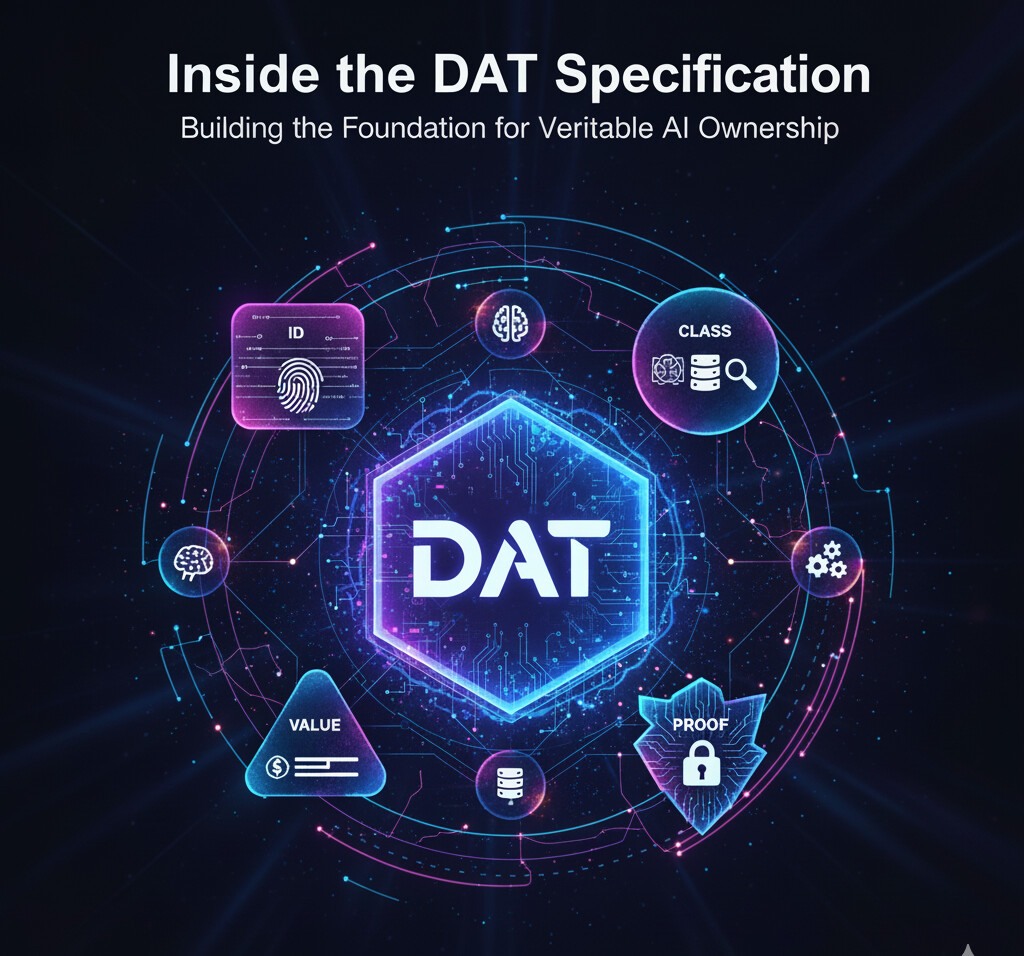
Each DAT carries a structured metadata schema that encodes four main dimensions:
| Field
| Description |
|----|----|
| ID | Unique identifier for the asset. |
| **CLASS
**
| Defines the category — e.g., dataset, model, or inference output. |
| **VALUE
**
| Represents quota or economic value (like usage capacity or revenue share). |
| PROOF | Verifiable evidence (ZK proof, TEE attestation, etc.) authenticating the asset’s integrity. |
This modular structure ensures that every AI contribution — whether a dataset or model checkpoint — can be anchored, verified, and monetized under one unified standard.
 Beyond Metadata: Embedding Rules into Tokens
The DAT specification goes beyond static information.
It encodes behavior through embedded fields like usage policies, licensing rights, and revenue-sharing logic.
For example, a DAT can define:
-
Usage limits: How many times a model can be invoked.
-
Expiration: When access or license validity ends.
-
Revenue share: How future profits are distributed among holders.
-
Rights: Whether the token can be transferred or used commercially.
This turns each DAT into a self-contained digital contract — a live policy layer for AI ownership and collaboration.
 Verifiability: The Proof Layer
A defining feature of DAT is its proof field, which acts as a bridge between on-chain records and off-chain computations.
It can include:
-
Zero-Knowledge Proofs (ZK-SNARKs / ZK-STARKs) for privacy-preserving validation,
-
TEE attestations from secure hardware environments, or
-
Cryptographic hashes linking to datasets stored on decentralized storage like IPFS or Arweave.
This ensures that every dataset or computation is provably authentic — without revealing private or sensitive data.
 Why DAT Matters for AI Builders
Traditional token standards fail to capture the full lifecycle of AI assets.
With DAT, ownership, access, and economic rights are combined under one programmable framework.
It’s especially powerful for:
-
AI marketplaces – Monetize data and models with verifiable proof and access control.
-
Collaborative research – Reward multiple contributors fairly via on-chain revenue logic.
-
Inference platforms – Enforce access limits or expiration directly through token rules.
-
Decentralized AI agents – Anchor every output and decision as an auditable on-chain record.
In short, DAT acts as a programmable digital wrapper around trust, access, and value in AI ecosystems.
 Governance: Enter the iDAO Layer
Every DAT can be governed by an individual DAO (iDAO) — a micro-governance model where token holders vote on how the asset is managed.
Imagine a dataset co-created by several users.
Instead of a single central owner, its DAT could be managed by an iDAO, allowing contributors to:
-
Decide on licensing terms,
-
Approve usage requests, or
-
Adjust revenue distribution.
This transforms static digital assets into living, community-governed entities that evolve through collective decision-making.
 The Road Ahead
LazAI’s Data Anchoring Token isn’t just another blockchain token — it’s a protocol for digital truth and fairness in AI ecosystems.
By standardizing how data and models are represented, verified, and rewarded, DAT sets the foundation for a transparent, incentive-aligned AI economy.
We’re moving toward a world where every dataset, model, and inference can carry its own proof, policy, and payout logic — all anchored securely on-chain through DAT.