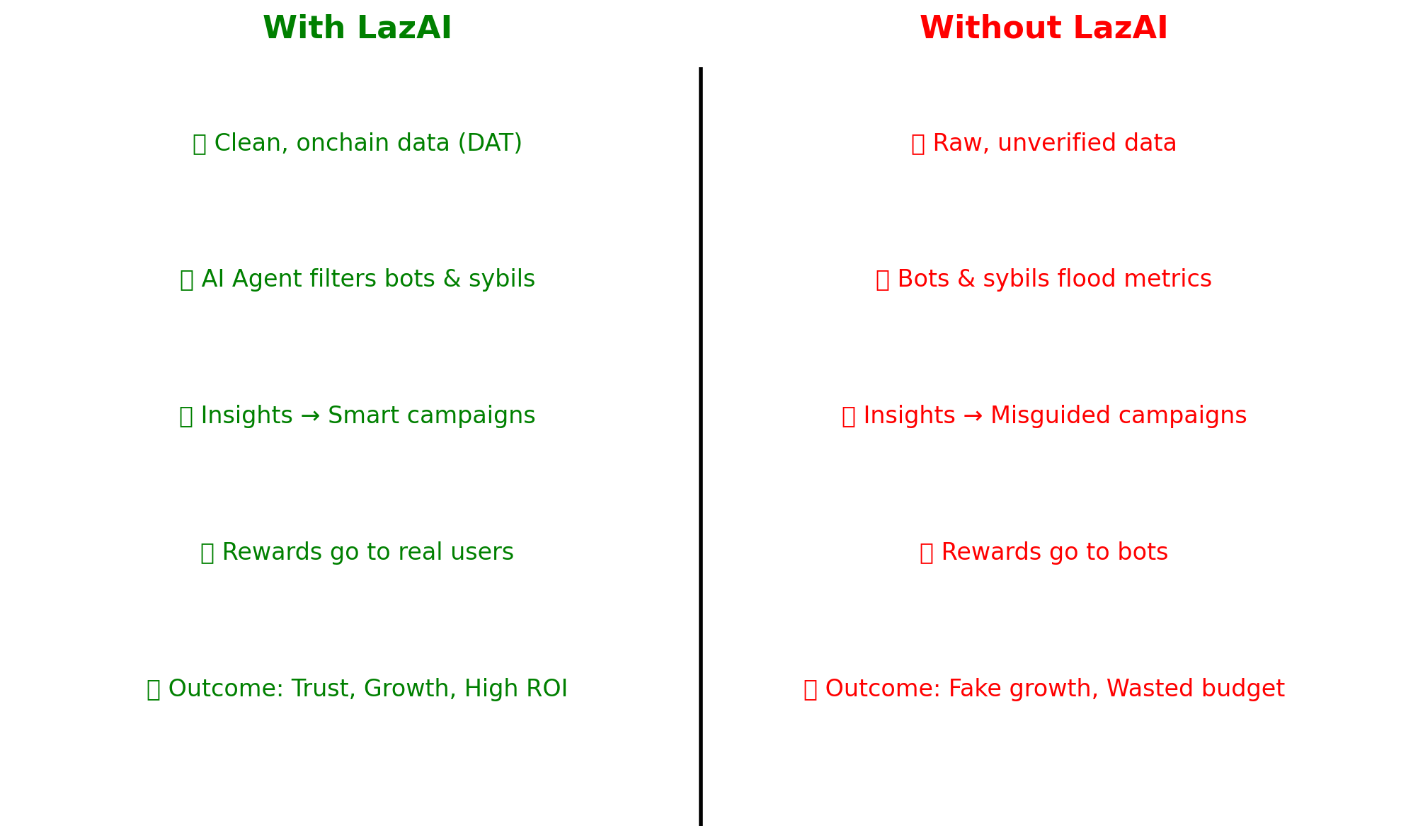
As I discussed here earlier, LazAI solves this by flipping the model: instead of AI being trained in closed black boxes, it is trained on **decentralized, user-owned, and verifiable data.
With LazAI, Web3 marketing doesn’t just survive the bad data storm—it **turns integrity into a competitive edge.**Here’s how an AI Agent built with LazAI makes a difference in Web3 marketing:
For projects: clearer ROI on campaigns, no more wasting tokens on fake users.
For communities: fairer distribution of rewards and recognition.
For the Web3 industry: a higher standard of data-driven marketing that builds real growth, not vanity numbers.
Here’s the concept of data filtering pipeline with LazAI:
flowchart LR
    U[Users & Communities] -->|Interactions, Quests, Posts| D[Raw Data Collected]
    D --> F[Filtering & Validation]
    F -->|Sybil Check, Reputation, Anchoring| C[Clean Onchain Data]
    C --> A[AI Training & Insights]
    A --> M[Marketing Decisions]
    M -->|Campaigns, Rewards, Growth| U
This flow shows:
Data starts with users.
LazAI filters and anchors it.
Only then is it passed into AI → producing trusted insights.
Marketing execution cycles back into the community.
Have you tried any other AI tools to improve marketing planing? Shere here
LazAI’s approach makes total sense: clean, verifiable data is the missing piece in most Web3 marketing.
Too many campaigns still burn budget on fake engagement, while this model turns trust into an actual growth driver. Curious to see more real-world case studies from the community here.
Thank yuu @Sheyda Really like this approach. Most quests today suffer from bad or shallow data, so tying AI training to user-owned and verifiable inputs feels like a real upgrade. If the insights are more transparent and trustworthy, projects don’t just grow numbers they build actual credibility.
Exactly! Decentralized AI is a single way to make sure in correctness and properness of conclusions for each request to AI. This what I mean in my reply to your another topic.
Most AI tools in marketing chase scale, but LazAI focusing on verifiable data could actually fix the trust gap. Clean inputs mean better insights, and in Web3 that’s the real edge.
AI Agents in LazAI don’t just look at “raw activity” like a wallet connecting or completing a quest — they look at anchored data through DATs (Data Anchoring Tokens).
Why bots are a problem elsewhere: On most quest/marketing platforms, bots can complete tasks, farm rewards, and look just like real users because all you see is a wallet address + an action. That’s raw, unverified data.
What LazAI does differently: Every action is anchored as a DAT, meaning it carries a history and provenance. The agent can check:
Has this wallet shown consistent, organic activity over time?
Does the account have a reputation score or contribution trail?
Are there sybil patterns (sudden cluster of wallets with the same behavior)?
Result: Bots can still “try” to act, but their actions don’t build meaningful DATs. Without verifiable history or reputation, they fail the filters. Essentially, DAT makes bot activity useless, because the AI agent will ignore or deprioritize low-quality data that doesn’t pass validation.
So, instead of chasing bots, LazAI just makes them irrelevant, only real, value-aligned interactions become part of the data economy.